
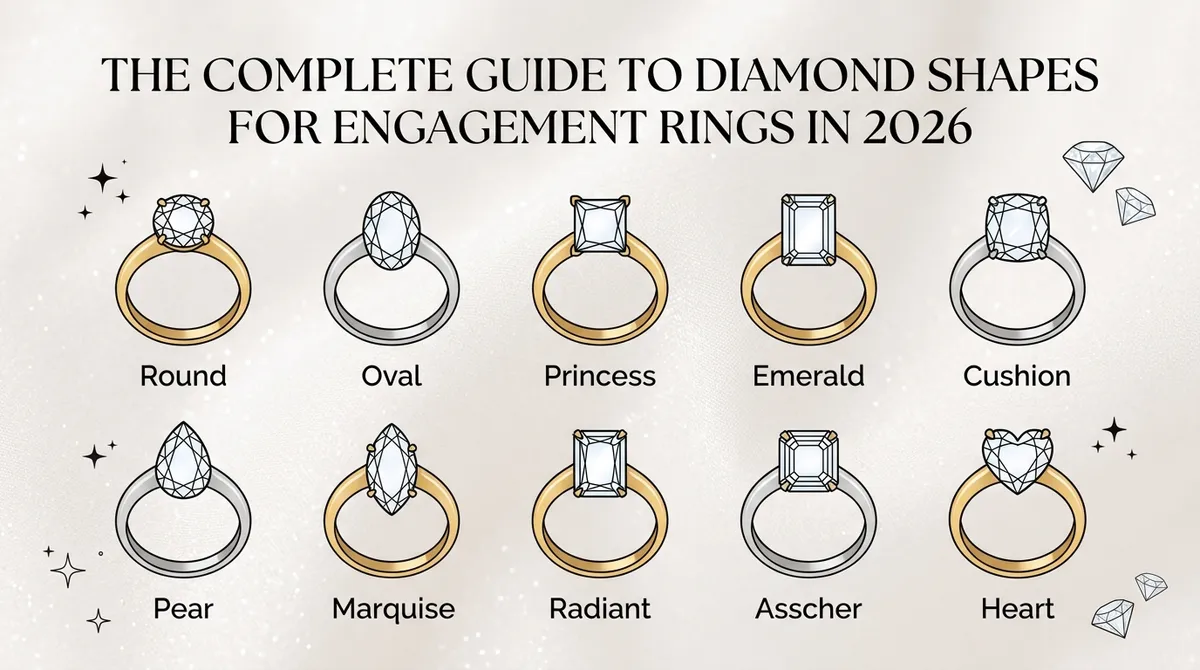
Best Diamond Shapes for Engagement Rings in 2026
Choosing the right diamond shape is one of the first decisions you'll make when shopping for an engagement ring. The shape affects the ring's overall personality, how large the diamond appears from above, how it interacts with light, and which settings may work best for the stone.
From the timeless sparkle of a round brilliant to the elegant lines of an emerald cut, there is no single "best" diamond shape for everyone. The right choice depends on your style, budget, hand proportions, desired sparkle, lifestyle and the setting you have in mind.
In this 2026 guide, Morin Jewelers breaks down the most popular engagement ring diamond shapes and explains what makes each one different, what to look for when shopping, and how to choose a center stone that works for you. If you'd like personalized guidance, you can always schedule an appointment with our team.
Diamond Shape vs. Diamond Cut: What's the Difference?
One of the most common sources of confusion when shopping for an engagement ring is the difference between a diamond's shape and its cut.
A diamond's shape describes its outline when viewed from above. Round, oval, pear, marquise, cushion and heart are examples of diamond shapes.
Cut style refers to how the diamond's facets are arranged and proportioned. Brilliant and step cuts are two major cut styles. Brilliant-style faceting is designed to return large amounts of light and create brightness, fire and scintillation, while step cuts use larger, parallel facets that create a more reflective "hall of mirrors" appearance.
This distinction matters because two diamonds with similar outlines can have very different appearances depending on how they are cut. For example, an emerald cut and radiant cut can both have rectangular outlines, but their facet arrangements create very different visual effects. For a deeper dive into how cut affects a diamond's performance, see our guide to the 4 C's of Diamonds.
Diamond Shape Comparison for Engagement Rings
Use this chart as a starting point when comparing popular engagement ring diamond shapes. Individual diamonds can vary significantly within the same shape, so the characteristics below should be used as general guidance rather than absolute rules.
| Diamond Shape | Typical Look | Light Performance | Face-Up Appearance | Durability Consideration | Popular Styles |
|---|---|---|---|---|---|
| Round Brilliant | Classic and timeless | Exceptional brilliance and sparkle | Balanced and symmetrical | No pointed corners; generally practical for everyday wear | Solitaire, halo, three-stone |
| Oval | Elegant and elongated | Strong brilliant-style sparkle | Large-looking and lengthening | No sharp points, but individual cut quality matters | Solitaire, hidden halo, vintage, three-stone |
| Emerald | Clean, sophisticated and architectural | Reflective rather than intensely sparkly | Elongated and open | Corners require appropriate protection | Bezel, solitaire, Art Deco, three-stone |
| Cushion | Soft and romantic | Brilliant or modified-brilliant sparkle depending on style | Square to elongated | Rounded corners offer useful protection | Vintage, halo, solitaire |
| Radiant | Modern and highly faceted | Strong brilliant-style sparkle | Square or elongated rectangular | Cropped corners can reduce point exposure | Three-stone, solitaire, halo |
| Pear | Distinctive and graceful | Brilliant-style sparkle | Elongated and finger-lengthening | Point requires careful protection | Solitaire, halo, toi et moi |
| Marquise | Dramatic and elongated | Brilliant-style sparkle | Very large-looking for its outline | Both points need protection | East-west, solitaire, halo |
| Princess | Modern and geometric | Brilliant-style sparkle | Square and substantial | Four corners need appropriate protection | Solitaire, channel, halo |
| Asscher | Vintage and Art Deco inspired | Step-cut reflection | Square and symmetrical | Corner protection is important | Bezel, solitaire, Art Deco |
1. Round Brilliant Diamond
The round brilliant is the classic choice for an engagement ring and remains the benchmark for traditional diamond sparkle. Its symmetrical outline and brilliant-style faceting are designed to maximize light return.
The round brilliant is also unique among common diamond shapes because GIA currently provides an overall cut grade for round brilliant diamonds. That makes the GIA cut-grade system particularly useful when comparing round stones — learn more in our 4 C's of Diamonds guide.
Why Choose a Round Brilliant?
- Classic, timeless appearance
- Exceptional brilliance and scintillation
- Highly versatile with different ring settings
- No pointed corners
- Easy to pair with many wedding-band styles
Best Settings for Round Diamonds
Round diamonds work beautifully in solitaire, halo, three-stone, pavé and vintage-inspired settings. A classic four- or six-prong setting can showcase the shape while allowing plenty of light into the stone.
Best For
- Maximum traditional sparkle
- Classic engagement rings
- Versatile styling
Consider
- Round brilliants can command a premium compared with many fancy shapes.
- Carat weight alone does not determine how attractive a diamond will look.
Browse round diamond engagement rings or shop loose round diamonds at Morin Jewelers.
2. Oval Diamond
Oval diamonds combine the brilliance associated with brilliant-style faceting with an elongated outline. Their length can create the appearance of a larger center stone while visually extending the finger.
One of the most important considerations when choosing an oval is the individual stone's proportions and appearance. Two ovals with the same carat weight can look noticeably different because of differences in length-to-width ratio, facet arrangement and depth.
Why Choose an Oval?
- Elegant elongated silhouette
- Strong brilliant-style sparkle
- Can appear larger face-up than some other shapes of the same weight
- Works with modern and vintage-inspired settings
- No sharp point at either end
What About the Bow-Tie Effect?
Some elongated brilliant diamonds, including ovals, can display a darker area across the center known as a bow-tie effect. A slight bow-tie can be part of the character of the shape, but excessive darkness can affect the stone's appearance. This is one reason it is valuable to view an oval in person or examine high-quality video before purchasing — schedule a consultation and we'll show you in person.
Best Settings for Oval Diamonds
Ovals are versatile in solitaire, hidden-halo, halo, three-stone and vintage-inspired settings. A yellow-gold setting can create a warm, classic appearance, while white gold or platinum provides a brighter, more traditional contrast.
Browse oval diamond engagement rings or shop loose oval diamonds at Morin Jewelers.
3. Emerald Cut Diamond
Emerald-cut diamonds are known for their long, clean step facets and sophisticated "hall of mirrors" appearance. Rather than producing the intense sparkle of a brilliant cut, emerald cuts emphasize flashes of light, clarity and crisp geometric reflections.
Because emerald cuts have large, open facets, inclusions and body color can be easier to see. That makes careful evaluation of clarity, color, proportions and the individual stone especially important — see our Diamond Buying Guide for tips.
Why Choose an Emerald Cut?
- Elegant and understated appearance
- Strong Art Deco and vintage associations
- Clean geometric lines
- Elongated appearance can visually lengthen the finger
- Distinctive alternative to a brilliant-cut diamond
Best Settings for Emerald Diamonds
Emerald diamonds pair beautifully with solitaire settings, three-stone designs, bezel settings and Art Deco-inspired rings. The cropped corners provide natural areas for prongs, while a bezel can provide additional protection.
Browse emerald cut engagement rings or shop loose emerald cut diamonds at Morin Jewelers.
4. Cushion Cut Diamond
Cushion diamonds have a square or rectangular outline with rounded corners that give the stone its soft, pillow-like appearance. They can range from classic brilliant cushions to modified-brilliant cushions with more intricate faceting.
Some modified cushion diamonds produce a distinctive "crushed ice" appearance, while other cushions have broader facet patterns and a more chunky, traditional sparkle.
Why Choose a Cushion?
- Soft, romantic outline
- Strong connection to vintage-inspired jewelry
- Available in square and elongated proportions
- Rounded corners provide less point exposure
- Works in both traditional and contemporary settings
Best Settings for Cushion Diamonds
Cushion diamonds work particularly well in halos, vintage-inspired settings, solitaire designs and three-stone rings. An elongated cushion can create a more lengthening appearance than a square cushion.
Browse cushion cut engagement rings or shop loose cushion cut diamonds at Morin Jewelers.
5. Radiant Cut Diamond
Radiant diamonds combine a rectangular or square outline with brilliant-style faceting. The result is a geometric shape with plenty of sparkle.
Radiants can be square or elongated. An elongated radiant can provide a lengthening appearance similar to an emerald or oval, while a square radiant has a more compact, symmetrical look.
Why Choose a Radiant?
- Strong sparkle with a geometric outline
- Available in square and rectangular proportions
- Cropped corners reduce sharp point exposure
- Modern appearance
- Works especially well in three-stone designs
Because fancy shapes do not receive the same overall GIA cut grade used for round brilliants, compare radiants by looking carefully at their proportions, symmetry and actual light performance.
Browse radiant cut engagement rings or shop loose radiant cut diamonds at Morin Jewelers.
6. Pear Shape Diamond
Pear-shaped diamonds combine a rounded end with a distinct point, creating a graceful teardrop silhouette. The shape can provide an elongated appearance and offers a distinctive alternative to the traditional round center stone.
Why Choose a Pear?
- Distinctive teardrop shape
- Brilliant-style sparkle
- Elongated appearance
- Works vertically or in creative orientations
- Excellent option for someone seeking something less traditional
Protecting a Pear Diamond
The point of a pear diamond deserves particular attention when selecting the setting. A properly designed prong or protective setting can help shield the tip from impact.
Symmetry is also important. The two sides of a pear should create a balanced outline, and the point should align naturally with the center of the rounded portion.
Browse pear shaped engagement rings or shop loose pear shaped diamonds at Morin Jewelers.
7. Marquise Diamond
The marquise is one of the most elongated diamond shapes and is known for creating substantial visual coverage across the finger. Its two pointed ends give it a dramatic silhouette.
Why Choose a Marquise?
- Large-looking elongated outline
- Distinctive vintage-inspired character
- Brilliant-style sparkle
- Can visually lengthen the finger
- Works especially well in statement and east-west designs
What Should You Look For?
Symmetry is particularly important with marquise diamonds. The two halves should look balanced, and the points should align. Some marquise diamonds can also display a bow-tie effect, so viewing the individual diamond is important.
Because both ends are pointed, the setting should provide appropriate protection against impact.
Browse marquise engagement rings or shop loose marquise diamonds at Morin Jewelers.
8. Princess Cut Diamond
Princess-cut diamonds have a square outline and brilliant-style faceting, giving them a crisp geometric appearance with plenty of sparkle. They are a strong choice for someone who likes modern lines but still wants a lively brilliant-style center stone.
The four corners deserve particular attention when selecting a princess diamond because sharp corners can be more exposed to impact. A properly designed setting can help protect those areas.
Best Settings for Princess Diamonds
Princess diamonds work well in solitaire, channel-set, halo and contemporary three-stone designs. Bezel or protective settings can provide additional corner coverage.
Browse princess cut engagement rings or shop loose princess cut diamonds at Morin Jewelers.
9. Asscher Cut Diamond
The Asscher cut is a square step-cut diamond associated with Art Deco design. Its concentric geometric facets create a distinctive hall-of-mirrors effect when viewed face-up.
Like an emerald cut, an Asscher can reveal inclusions and color more readily than many brilliant-cut diamonds. Carefully evaluating the individual stone is therefore especially important.
Why Choose an Asscher?
- Strong Art Deco character
- Highly symmetrical appearance
- Elegant step-cut reflections
- Distinctive alternative to brilliant-cut shapes
- Excellent choice for vintage-inspired designs
Shop loose Asscher cut diamonds or talk with us about building an Asscher cut custom engagement ring.
Which Diamond Shape Looks Best on Different Fingers?
Diamond shapes can influence the visual proportions of an engagement ring, but there are no strict rules about which shape someone "should" wear. Finger length, finger width, ring proportions, band width, setting height and personal style all affect the finished appearance.
For a Lengthening Effect
Elongated shapes such as oval, pear, marquise and rectangular emerald or radiant diamonds can create a visual line along the finger.
For a Classic, Balanced Appearance
Round brilliant diamonds provide a symmetrical silhouette that works across a wide variety of hand proportions and ring designs.
For a Bold Geometric Look
Emerald, Asscher, princess and radiant diamonds offer stronger geometric lines and can create a distinctly architectural appearance.
For a Softer, Romantic Appearance
Oval and cushion diamonds offer softer curves, while pear and marquise shapes introduce more dramatic lines.
Not sure which shape suits your hand? Book an in-store appointment and try on a variety of shapes side by side.
Which Diamond Shape Looks Largest on the Finger?
Elongated shapes such as marquise, oval and pear diamonds can create the impression of greater face-up size because more of their outline stretches across the finger.
However, carat weight does not tell the whole story. Two diamonds with identical carat weights can have different face-up dimensions because of their proportions and depth.
If visible size is important to you, compare the diamond's actual length and width—not simply its carat weight—and look at the stone from the top. Our full diamond inventory lists exact measurements for every stone.
Which Diamond Shapes Are Best for Everyday Wear?
Diamond is extremely hard, but hardness does not mean a diamond is impossible to chip. Impact can damage areas such as exposed points, corners or vulnerable girdle areas.
Round, oval and rounded-corner cushion shapes avoid the sharp points found on pear and marquise diamonds. Shapes with corners or points can still be excellent choices for engagement rings, but the setting should provide appropriate protection.
Shapes Requiring Extra Attention to Protection
- Pear: protect the pointed tip.
- Marquise: protect both pointed ends.
- Princess: protect the four corners.
- Radiant: evaluate the corners and setting design.
- Emerald: make sure the corners and girdle are appropriately protected.
- Asscher: protect the corners with a suitable setting.
Your lifestyle should also influence the setting. If your hands regularly encounter hard surfaces, tools or physical work, talk with a jeweler about a setting that provides additional protection. Our jewelry restoration and tip & prong repair services can also help keep any shape secure for years of everyday wear.
Best Engagement Ring Settings for Different Diamond Shapes
The setting is more than a decorative choice. It affects how much of the diamond is visible, how the stone sits on the finger, how the shape is emphasized and how well vulnerable areas are protected. You can browse settings for your stone or use our engagement ring builder to design your own.
Solitaire
A solitaire puts the center diamond at the heart of the design. It works particularly well with round, oval, emerald, cushion and radiant shapes.
Halo
A halo surrounds the center stone with smaller diamonds and can increase the overall visual presence of the ring. Halo proportions should complement—not overwhelm—the center stone.
Bezel
A bezel surrounds the diamond's perimeter with metal and can provide additional protection. Bezel settings can be especially appealing for people who prefer a sleek, lower-profile design.
Three-Stone
Three-stone rings can highlight elongated center stones such as oval, emerald, radiant and pear diamonds. Side stones can be selected to complement the proportions of the center.
East-West Setting
An east-west setting places an elongated diamond horizontally across the finger. Ovals, emeralds, elongated cushions, radiants, pears and marquises can all create distinctive east-west designs.
Prefer to start with a finished ring rather than build one piece by piece? Explore our proposal-ready engagement rings.
How Diamond Shape Can Affect Your Budget
Diamond shape can influence price, but it should not be viewed as a simple ranking of expensive versus inexpensive shapes.
Round brilliant diamonds often carry a premium compared with many fancy shapes. Choosing an oval, cushion, pear, marquise, radiant or other fancy shape may provide an opportunity to prioritize face-up size or a distinctive appearance while managing the overall budget.
The most important consideration is how the individual diamond looks—not simply the shape name or price per carat. Whatever shape you choose, Morin Jewelers offers flexible financing options to help make your ring fit your budget.
Where to Focus Your Budget
- Start with the shape and overall appearance you prefer.
- Compare the actual dimensions of stones.
- Evaluate proportions and symmetry.
- Consider color and clarity based on the shape.
- Review the diamond's light performance.
- Choose a setting that complements and protects the stone.
- Compare the complete ring—not just the center diamond.
How to Choose the Right Diamond Shape
If you're overwhelmed by the number of diamond options, start with the way you want the finished ring to look rather than starting with carat weight.
What to Look at Before Buying a Diamond
Once you've narrowed down your preferred shape, evaluate the individual diamond carefully. A diamond's shape is only the beginning.
- Proportions: Do the length and width create the look you prefer?
- Symmetry: Does the outline look balanced?
- Light performance: Does the stone appear bright and lively?
- Clarity: Are inclusions visible to the eye?
- Color: Does the diamond appear appropriately white or warm for your setting?
- Measurements: How large does the diamond actually appear face-up?
- Setting: Does the mounting complement and protect the diamond?
- Lifestyle: Will the ring work comfortably with your everyday routine?
Shopping for an Engagement Ring in Southbridge and Central Massachusetts?
Choosing a diamond online can give you plenty of options, but seeing different shapes side by side can make the decision much easier. An experienced jeweler can help you compare proportions, settings, diamond quality and how each shape looks on your hand.
If you're shopping for an engagement ring in Southbridge, Sturbridge, Charlton, Dudley, Webster, Worcester County or throughout Central Massachusetts, Morin Jewelers can help you compare diamond shapes and explore traditional engagement ring designs or custom engagement ring designs.
An in-person consultation is especially helpful if you're deciding between shapes such as oval versus round, emerald versus radiant, or pear versus marquise. Book your consultation today.
Frequently Asked Questions About Diamond Shapes
What is the most popular diamond shape for an engagement ring?
Round brilliant remains the classic and most widely recognized engagement ring diamond shape. However, oval, emerald, cushion, radiant, pear and marquise diamonds offer popular alternatives for shoppers looking for a different silhouette or style. See our list of the most popular diamond shapes for more.
What diamond shape looks the largest?
Elongated shapes such as marquise, oval and pear can create a larger-looking appearance because of their long face-up outlines. Actual measurements and proportions should be compared when evaluating size.
Which diamond shape has the most sparkle?
Round brilliant diamonds are renowned for exceptional brilliance, fire and scintillation. Brilliant-style fancy shapes such as oval, pear, marquise and radiant can also provide substantial sparkle, although the appearance varies from one diamond to another.
What is the difference between an emerald cut and a radiant cut?
Both can have rectangular outlines, but their faceting is different. Emerald cuts use step-cut facets that create broad, mirror-like reflections, while radiant cuts use brilliant-style faceting designed for a more sparkly appearance.
Are oval diamonds more durable than pear or marquise diamonds?
Oval diamonds do not have the exposed pointed tips found on pear and marquise diamonds, which can make them less vulnerable to impact at a point. However, durability depends on the individual diamond, its proportions, girdle and setting. A well-designed setting can provide important protection.
Do fancy-shaped diamonds receive a GIA cut grade?
GIA currently provides an overall cut grade for standard round brilliant diamonds. Fancy shapes such as oval, pear, marquise, cushion, emerald and radiant are not assigned the same overall GIA cut grade because of the wide variety of proportions and facet arrangements. For these shapes, evaluate the individual diamond's proportions, symmetry, polish and appearance, as outlined in our 4 C's of Diamonds guide.
Which diamond shape is best for a vintage engagement ring?
Cushion, emerald, Asscher and oval diamonds can all work beautifully in vintage-inspired engagement rings. The setting, metal, milgrain, engraving and side-stone design can be just as important as the center stone in creating a vintage appearance.
Should I choose my diamond shape before choosing the setting?
Ideally, consider them together. Certain shapes have specific setting considerations, particularly diamonds with pointed ends or corners. Choosing the shape and setting as a pair can help ensure the finished ring looks balanced and provides appropriate protection — our ring builder lets you try shape-and-setting combinations before you buy.
What should I prioritize when choosing a diamond?
Start with the overall appearance you want, then evaluate the individual stone's proportions, light performance, color, clarity, carat weight, symmetry and setting. The best combination depends on your priorities and budget. Our Diamond Buying Guide can help you weigh these factors.
Find the Right Diamond Shape at Morin Jewelers
Still deciding between an oval, round, emerald, cushion, radiant or another diamond shape? Seeing different stones and settings in person can make the choice much easier.
At Morin Jewelers, we can help you compare diamond shapes, discuss setting options and create an engagement ring that fits your style, lifestyle and budget.
- Visit Our Showroom: 409 Main St., Southbridge, MA 01550
- Call: (508) 764-7250
- Schedule a Consultation: Book an Engagement Ring Consultation